

Brand tracking provides insights into what motivates donors to support organizations. During the past year, TrueSense Marketing has tracked the Ronald McDonald House® brand — not just to understand the impact of its brand refresh, but also to better understand the motivations of its donors.
This ongoing brand-tracking effort surveys philanthropic individuals and provides insights into donors’ decisions. It measures not just how aware someone is of Ronald McDonald House, but also what drives their movement down the donor funnel from awareness to consideration to usage (donor) to preference (repeat donors). The data tells a nuanced story and provides actionable insights for direct response.
Among the takeaways we’ve uncovered in our latest brand-tracking research are these:
Although the brand rollout continues across the country, tracking shows that general awareness across all audiences is slightly down, while all other parts of the funnel remain stable.
Digging deeper into the awareness data, we see that awareness is up with audiences older than 55, while audiences in the 18–44 age range still have room for growth in awareness.
Members of the younger audience who are aware are more likely to donate to Ronald McDonald House than they are to give to other tracked nonprofits. Older donors, specifically those older than 65, are more aware, but they have a greater fall-off rate when it comes to who ultimately donates. This segment underperforms compared to other tracked nonprofits.
This data is promising because it indicates that younger audiences are drawn to the refreshed brand. It also shows the importance of continued investment into awareness — especially with younger audiences that will fuel future giving. Brand-tracking data shows that when people report knowing Ronald McDonald House well, they are three times more likely to give.
The surveys ask several questions to better understand the motivations of philanthropic individuals. These questions provide insights into what matters when it comes to messaging. The data shows similar trends for those older than 45 and those younger than 45.
The 45-plus donors tend to base their decisions on trust in an organization. This shows their practical nature and highlights the need to reinforce trust at every stage of the donation process. Trust-reinforcing measures could include having recognizable individuals sign letters, incorporating badges and awards, and using transparent language.
On the other hand, younger donors are more motivated by shared values: a softer, more emotional driver that shows the importance of building connections with these individuals. Shared values can be emphasized through stories about specific situations, imagery that fosters a connection, and language that highlights the unmet need.
This data can help shape not only the language in appeals, but also the overall message that goes to market across appeals and stewardship efforts.
We live in a multichannel world, so it’s not surprising that people have multiple channels of influence, and that those channels may differ from their preferred transaction channels. Studies show that five to seven different channels influence decisions, and again, trends emerge for those older and younger than 45.
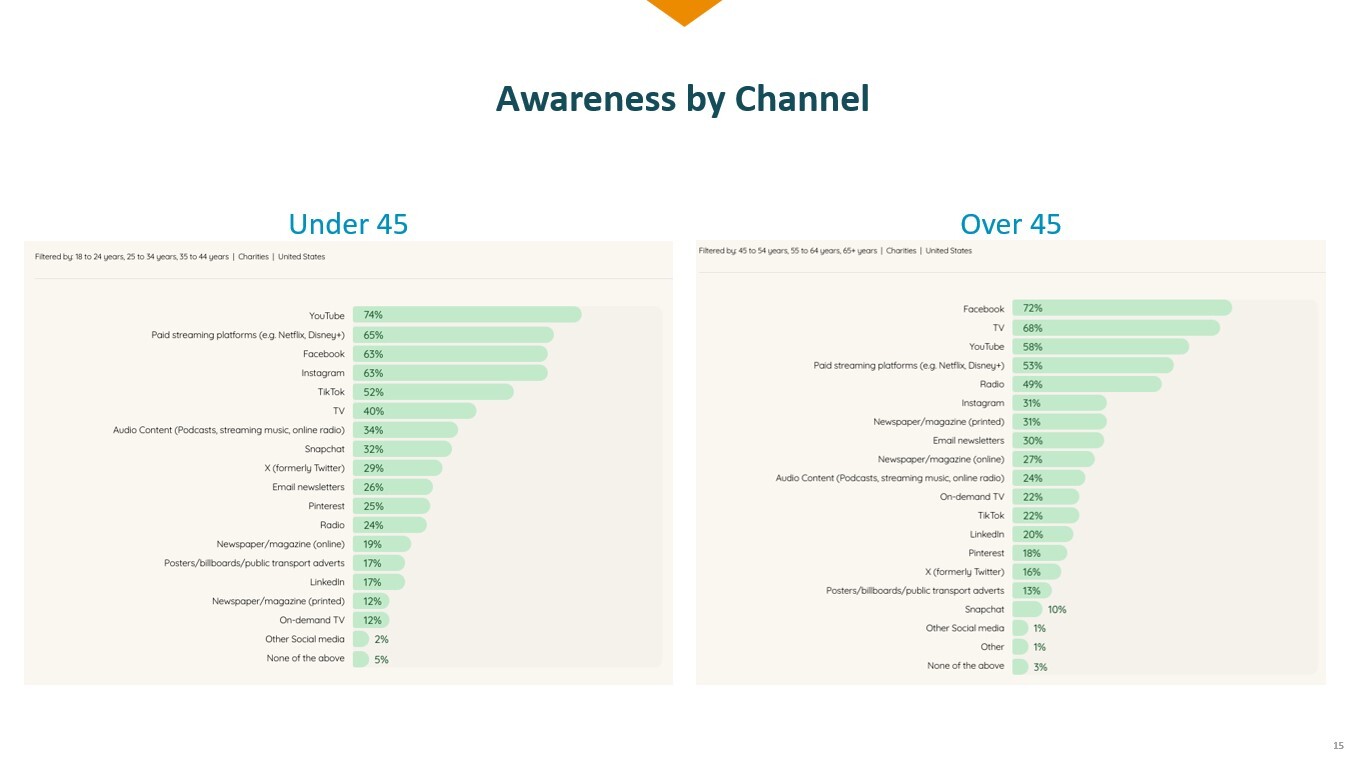
The top five channels where 45-plus audiences report that they learn about new brands and organizations are Facebook (72%), TV (68%), YouTube (58%), streaming video platforms (53%), and radio (49%).
In contrast, the top five channels for the younger-than-45 audience are YouTube (74%), streaming video platforms (65%), Facebook (63%), Instagram (63%), and TikTok (52%).
There’s a lot to unpack with this data, but this is one of the reasons why co-targeting and donor wraps — efforts that target audiences receiving direct mail appeals — result in a lift in overall performance. It’s also part of the reason why dual-channel programs saw a greater year-over-year increase in the average first gift versus direct mail appeals in 2025.
Brand-tracking efforts provide a wealth of useful data. By combining giving data with third-party data, including brand tracking, direct response programs can become more efficient and effective.
The ongoing brand-tracking effort sees survey results reported monthly, which allows current data to inform decisions and ensure that a near–real-time pulse is kept on how philanthropic individuals feel about the Ronald McDonald House brand.
Stay tuned for updated data from our ongoing brand-tracking efforts in our webinars and newsletters.