

For several decades now, fundraisers have relied on a comforting narrative that follows this general formula:
New donors begin with modest gifts. Fundraisers believed that — through thoughtful cultivation — these donors could then be steadily and predictably shepherded to the top of a pyramid toward major giving.
This donor pyramid framework suggests that stewardship and disciplined ask logic, combined with the occasional push for upgrading, guide supporters from low-dollar entry contributions to mid-level donations to, eventually, major or transformational giving.
And although we’ve all heard the memorable stories about the $5 supporter who unexpectedly leaves a $5 million bequest, the reality reflected in the data tells a very different story about how often that actually occurs. It can be challenging for fundraisers to know where the truth resides because these very rare outlier situations can reinforce the myth of the donor pyramid.
We performed several analyses across nearly 200 nonprofit organizations over a 20-year time span, and the insights from those investigations paint a far more nuanced picture of how donor gift progression typically unfolds.
To begin, we compared a donor’s first gift to their largest lifetime gift to see how much movement occurs in giving amount.
The chart below illustrates donors segmented by two factors: their first gift amount (along the vertical axis) and their largest gift amount (along the horizontal axis).
The dark-blue boxes on the left represent the percentage of donors whose largest gift is roughly in line with their first gift, indicating consistent giving behavior over time.
As you move to the right across the chart, each successive set of boxes represents the percentage of donors whose largest gift falls into a higher giving tier than their first gift. In other words, the farther right you go, the greater the donor’s growth in giving level.
This visualization helps us identify the percentage of donors who actually increased their giving significantly since their first contribution, and those donors who maintained a steady giving pattern.
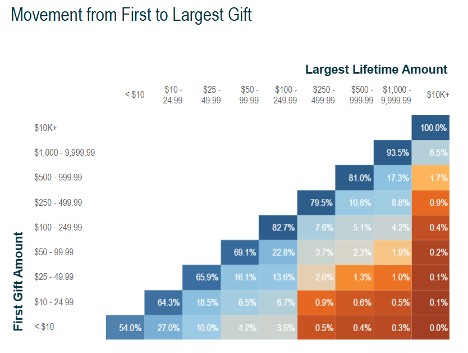
The data reveals three consistent truths seen across nearly every nonprofit organization’s donor file — and these findings refute standard industry beliefs about upgrading.
In fact, even for those donors who do upgrade to elevated largest lifetime gifts, the majority do not sustain that higher level. Many of these “upgraded” donors eventually revert toward their average gift amount, which tends to be closer to their initial gift level. This phenomenon can sometimes be obscured when data is viewed only at the moment of peak generosity.
The insights derived from the evidence displayed in this chart challenge a long-held fundraising assumption and underscore a critical principle: Donor behavior is anchored to initial gift levels.
Said another way, proximity matters when thinking about donors’ potential for upgrading. Most mid-level donors do not emerge from small-gift pipelines; rather, most made their initial gift in any given fiscal year at or near the mid-level threshold.
Although the vast majority of mid-level donors are acquired at that level, there is a minority of donors who do upgrade their way into mid-level programs. Understanding how long it takes for these supporters to arrive at the mid-level tier helps organizations plan sustainable fundraising strategies because such donors rarely reach mid-level quickly. Many follow a path that unfolds over several years, shaped by personal factors, strategic outreach, and ongoing engagement.
To understand what causes donors to upgrade to mid-level, we analyzed the tenure of donors in mid-level programs. In this analysis, we observed a U-shaped pattern that clearly identified two predominant tracks: a fast track and a slow track.
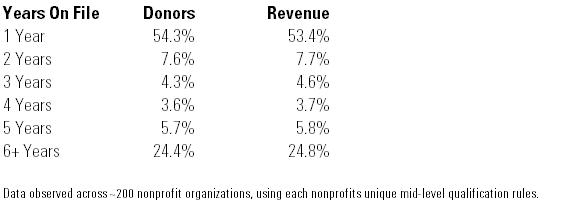
The data shows that nearly half of all mid-level supporters in any given fiscal year are new to the nonprofit organization. In fact, nearly two-thirds of mid-level donors and revenue are generated from supporters with two years or fewer on the donor file.
Yet for those mid-level supporters not acquired at mid-level in the first year, it takes an average of eight years to reach mid-level. Although that timeline may seem long, it aligns with several benchmarking studies and what many nonprofits see in their own data.
The simple truth is that supporter behavior cannot be changed quickly, and upgrades rarely happen overnight. Significant changes in gift amount result from repeated, meaningful interactions and a demonstration that increased giving has an increased impact on the mission. Personalized outreach, program updates, donor recognition, and invitations to get involved serve as essential points of reinforcement. These repeated interactions build trust and help donors feel confident in offering greater support over time.
This evidence does not diminish the value of cultivation and stewardship. In fact, we believe it refines it. How critical does this new information make the first 12 to 18 months of the relationship with newly minted mid-level supporters? What might you change about your initial interactions with them? And although only a small minority of donors arrives at mid-level later, upgrading still occurs — it just unfolds more gradually, shaped by years of consistent engagement, trust building, and demonstrated impact.
Patience, therefore, is not optional. It is strategic when thinking about your mid-level program. Given that nearly half of mid-level donors in any given year are new to the organization — not long-nurtured small-gift givers — nonprofits must recognize the impact this can have on their ability to drive mid-level revenue in the near term. This forces conversations to focus on the audience design of acquisition and engagement efforts that meet donors where they begin, rather than where the nonprofit might wish them to go.
By grounding mid-level strategy in empirical evidence, fundraisers can replace inherited myths with informed practice that will strengthen both donor experience and long-term financial health.
As mentioned above, many organizations treat their mid-level program as a temporary step on the climb to major gifts. Because of this mindset, nonprofits often have unrealistic expectations about how many of these supporters will “naturally” upgrade out of the mid-level to major giving, and how quickly this upgrade might take place.
Certainly, a small number of mid-level supporters will upgrade to major giving — and some will do it quickly — but the data suggests that the giving comfort zone for most mid-level supporters remains in the mid-level program. Nonprofits should respect that preference because mid-level supporters represent a substantial revenue stream on their own. For donors who are most comfortable giving at this level, your mid-level program isn’t a bridge to major giving — it’s a home.
Across nearly 200 organizations’ worth of data, we found that mid-level supporters tend to make up 3% to 7% of active donor counts, but they generate as much as 35% to 40% of the total program revenue. This disproportionate impact highlights their critical financial role.
Mid-level programs should therefore focus on retaining these core contributors versus upgrading them, which requires tailored engagement, stewardship, and appreciation, as well as intentional ask logic that isn’t always geared toward driving outlier major gifts.
Giving, at its core, is often an act of sacrifice. For many donors, especially those in the mid-level range, a decision to contribute represents a deliberate choice between philanthropy and other personal or financial priorities. Unlike major donors who may have more disposable wealth, mid-level donors are often giving from funds that could easily be allocated elsewhere. This makes their generosity particularly meaningful.
Remember that giving level does not always correlate directly to income. It is not uncommon to see individuals with modest incomes represented in the mid-level giving range because they may have a measure of discretionary wealth from savings, reduced expenses, or a recent change in circumstances that allows them to make a more significant contribution than their income might suggest.
In some cases, a mid-level gift may be a one-time occurrence driven by an exceptional situation such as an inheritance, a work bonus, or another windfall. For these donors, the decision to give is often deeply personal and values driven, reflecting gratitude, alignment with the organization’s mission, or a desire to make a meaningful impact at a pivotal moment in their lives.
Ultimately, mid-level donors’ philanthropy stems from choice and conviction, not obligation. Understanding this mindset is essential in building authentic relationships, acknowledging the significance of their sacrifice, and communicating impact in a way that reinforces their sense of purpose and belonging.
Based on this understanding of mid-level donors, it’s important that a well-rounded mid-level program speaks to both the minds and the hearts of its donors.
First, efforts must include moments that say:
“We recognize you.” Mid-level donors respond to feeling known and seen by your organization.
“We appreciate your interest.” Mid-level donors have a longer attention span and curiosity for what your organization has to share. Provide them with opportunities to engage with richer content and expose them to the multiple facets of your mission.
“We honor your generosity.” Mid-level donors can typically warrant more elevated treatments from an ROI perspective, but choose these efforts wisely. It’s important to strike a balance between specialized treatment and demonstrating that you’re leveraging their investment wisely.
Understanding mid-level donors’ motivations and behaviors only partially unlocks their potential. To fully engage these vital supporters, organizations must implement strategic approaches that deepen relationships, foster loyalty, and encourage increased giving over time. The most successful programs balance outreach for stewardship, retention, and upgrading.
Relying on a single channel risks disengagement. Effective strategies combine multiple touchpoints to reinforce messages. For example, sending personalized thank-you letters by mail complements targeted emails that share updates or impact stories aligned with donors’ interests, creating a layered, meaningful experience.
CRM systems track donor interactions across channels, enabling staff to understand each donor’s engagement stage. Automation supports personalized communication at scale without sacrificing the human element.
Traditionally, organizations have relied on intuition or broad demographic and wealth attributes to identify these donors. Today, your first-party donor data should be the fuel powering predictive AI solutions that provide deeper, more precise insights and enable targeted cultivation based on evidence rather than assumptions.
Identification: This should be the word that’s on your mind whenever you think about using predictive modeling to enhance your mid-level program.
To give you a sense of how using more precise identification might benefit your organization, consider this real example of an anonymized nonprofit that scored its donors with our machine-learning–powered GPS solution. The results are grouped by scores into categories that reflect where the predictive intelligence would slot each donor based on their likelihood to give and at what levels during the next 12-18 months.
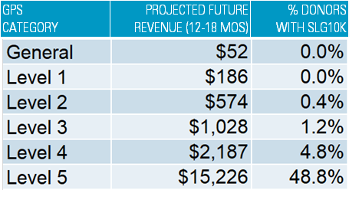
In this case, the nonprofit began its mid-level program at $1,000 annual cumulative giving (which would align with GPS Level 3) and began its major-donor and portfolio assignments at $15,000 annual cumulative giving (which would align with GPS Level 5).
When we use this new identification process to compare against the nonprofits’ legacy mid-level and major-donor assignment logic, we find that there are some striking differences:
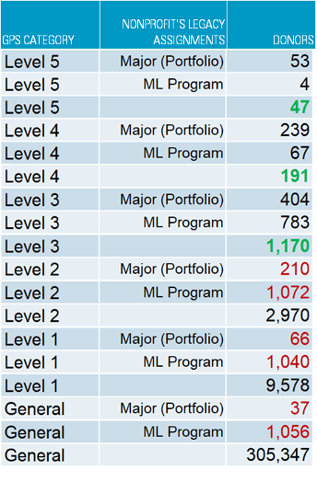
In this table, you can see that the nonprofit had donors (in red) whom it had mistakenly placed into mid-level or major-donor treatments. The GPS category for these donors suggests that they are statistically unlikely to contribute at the levels required to qualify for mid-level or major-donor programs.
You can also see where the nonprofit had donors (in green) whom it had stranded in its general annual-fund program that the GPS category suggests are statistically likely to give above $1,000 during the next 12-18 months. This type of identification and audience reconciliation is a critical step toward driving better results from your mid-level and major-donor programs.
“Well, hold on,” you might be thinking. “Just because your GPS category suggests how donors are going to give, that doesn’t mean they will.”
That’s an important reality. However, reviewing this organization’s results during the subsequent 12 months proved that the GPS categories weren’t merely close, but extremely accurate in what they suggested for future revenue contributions for the donors identified.
For each GPS category, we have the upper and lower confidence interval showcased in the tan cyclone chart. This area represents the upper and lower 12-month projected revenue contribution for donors in each GPS category. Plotted against that tan cyclone in the same chart are the actual results from those donors (in blue) during the subsequent 12 months.
In every case, the machine-learning–powered projection falls exactly in line with the modeled expectations. This type of identification, reassignment, and performance underpins the critical need for nonprofits to use artificial intelligence and machine learning instead of legacy institutional beliefs.

Prompt follow-up after donations reinforces positive feelings and introduces opportunities for deeper involvement. Marking anniversaries or gift milestones shows attentiveness and appreciation, strengthening donor bonds.
And don’t be afraid to ask for a second gift. In fact, we analyzed thousands of donors who had upgraded to mid-level and found that one of the leading indicators of upgrading was making a second gift to the organization within 180 days of the first gift. This creates a bond and a habit of giving that primes donors for ongoing, long-term support.
Major-gift officers who understand individual motivations can personalize conversations beyond scripted asks. However, the officer-to-donor ratio at the mid-level is still often one to many, making it difficult to personally engage with all mid-level donors in a meaningful way.
This is why it’s important that mid-level gift officers and annual giving program managers collaborate to create the best donor experience through a blend of personal and mass outreach. Often organizations structure their goals in a way that unwittingly creates unhealthy competition between gift officers and annual giving programs for “credit” in securing a gift. These internal challenges can inadvertently lead to poor donor experience and put mid-level giving in jeopardy. The most robust and successful mid-level programs implement a hybrid approach with shared goals and objectives.
Fundraising succeeds when solicitation pairs with stewardship. Meaningful stewardship includes sharing impact stories, previewing upcoming initiatives, and inviting donor feedback: actions that transform donors from passive contributors to engaged partners.
Not all engagement requires immediate asks. Building trust through consistent stewardship creates credibility and positions your organization as transparent and appreciative, naturally leading to increased support over time.
Data-driven insights allow for precise message tailoring based on giving history, interests, and life circumstances. If a donor consistently supports your work but recently shows an interest in environmental programs, for example, communications should highlight related projects or events. Referencing specific interests, gifts, or milestones makes donors feel recognized and valued.
Respect for cultural and regional differences related to solicitation and stewardship enhances receptivity. Tailoring approaches to align with diverse donor values demonstrates respect and strengthens relationships.
Despite long-held beliefs, the reality about the donor pyramid is that it’s something very few donors actually climb. Most mid-level donors come through the door at or around mid-level, and only a rare few increase their support to join the major-giving ranks throughout nearly a decade, on average.
Therefore, the top priority for your mid-level giving program should be growing and retaining this valuable group of donors. Upgrading donors out of mid-level should be a positive by-product of the program for the rare few, but not the focus.
In the broader question of whether mid-level donors are born generous or shaped by marketing strategy, the answer — and the path to success — lies in blending a bit of both. Recognize the inherent potential of donors who are at or near the threshold for mid-level inclusion, and apply tailored cultivation to unlock your donors’ full capacity to support your mission.
Effective engagement balances thoughtful asking with continual stewardship, using data-driven personalization to build rewarding, long-term donor relationships. Integrating multiple channels, timing outreach strategically, fostering trust, and respecting cultural nuances create a foundation for sustainable growth.