

If your awareness strategy assumes that every generation discovers your organization in the same way, this data suggests otherwise.
We recently conducted a brand-awareness survey for The Salvation Army to better understand where people remember seeing or hearing about the organization. We looked across four age groups and asked one straightforward question: Where have you recently seen or heard about this organization?
The results tell a clear story. The channels where people notice shift dramatically with age. In some cases, the channels don’t just perform differently — they completely switch places.
One important note before diving in. This survey measures recalled awareness, not attribution. When someone says they saw The Salvation Army on Facebook, they’re telling us where they remember encountering the brand recently, but that encounter wasn’t necessarily what inspired them to donate. Awareness and giving are connected, but they aren’t the same thing.
The single clearest pattern in the data is how completely word of mouth and traditional television reverse as people get older. Among 25- to 34-year-olds, conversations with friends, family, and coworkers are the leading source of awareness at 25%, and traditional TV sits near the bottom at 10%. When you move up the age curve, the two lines swap. By ages 45-54, the picture flips: Television climbs to 22%, and word of mouth drops to 16%. The crossover happens right in the middle of the donor age spectrum.
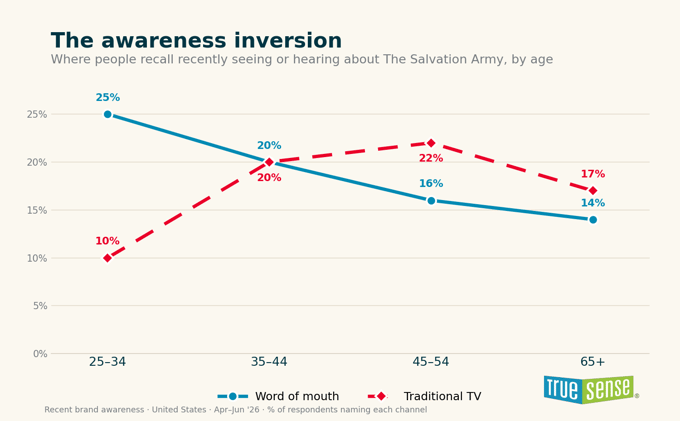
Word of mouth leads younger audiences; traditional TV leads older ones.
The lines cross between the 35-44 and 45-54 age bands.
This has real planning implications. If most of your awareness dollars go into television, you’re putting the greatest emphasis on a channel that younger audiences are least likely to notice. If your strategy leans heavily on social sharing and peer-to-peer buzz, you’re missing many of the older supporters who still discover organizations through traditional media.
Looking across the top channels makes the differences even more obvious. Facebook, YouTube, and Search all perform best with younger adults, then steadily lose ground with each older age group. In-person events rank among the top three awareness drivers in every generation we surveyed. They reach their highest level among adults ages 35-44, where nearly one in four respondents recalled seeing the organization at an event.
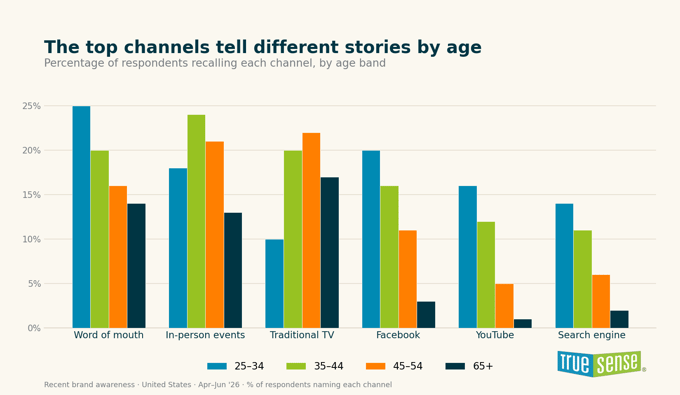
The six most-cited channels, compared across all four age bands.
The one channel that holds: In-person events rank in the top three in every age band and peak at 24% among 35- to 44-year-olds. It’s the closest thing to a truly cross-generational awareness driver in the entire dataset, and the one that’s most easily underfunded when digital dashboards dominate planning.
When we grouped channels into broader categories, another pattern emerged. When averaged together, the digital and social channels (Facebook, YouTube, TikTok, Instagram, and Search) command real attention among younger audiences and then fall away almost completely. TikTok and Instagram reach effectively zero among those in the 65-plus age group. The physical and in-person channels (events, direct mail, radio, out-of-home, and print) start lower but decline far more gently, ending up as the dependable path to reach older audiences precisely where digital fails.
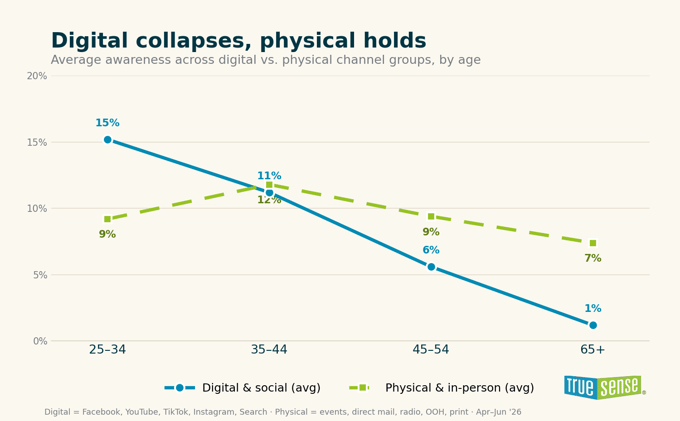
Average awareness across digital versus physical-channel groups. The digital line falls roughly 15 points across the age span; the physical line holds within a few points.
Unfortunately, the channels that are easiest to cut are often the ones reaching your oldest, most reliable donors. Direct mail, radio, and billboards rarely win the argument in a metrics review built around click-through and cost-per-acquisition. This data is a reminder that those channels are holding awareness steady in the segments that give the most consistently.
One finding stood out regardless of the channel. The share of respondents who simply couldn’t remember where they’d encountered the brand climbs sharply with age, from 25% among the youngest group to 47% among those 65 and older. Nearly half of the oldest, most donation-active audience can’t attribute their awareness to any specific source.
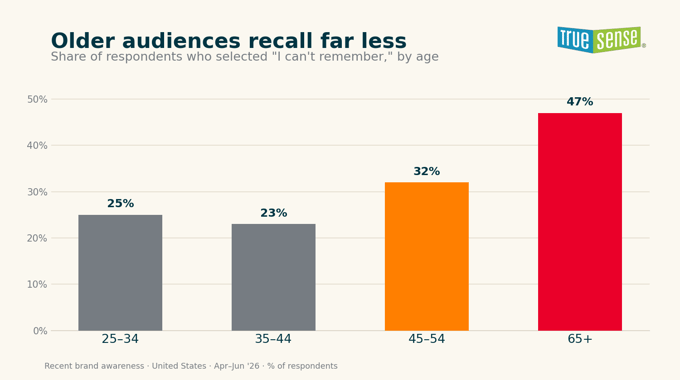
The “I can’t remember” response nearly doubles from the youngest to the oldest band.
This doesn’t make the older-audience data worthless. Older supporters are likely experiencing repeated exposure across multiple touchpoints that blend together over time. Instead of expecting a single campaign to stand out, this reinforces the value of showing up consistently. Familiarity builds through repetition, especially in channels that older audiences continue to engage with regularly.
Pulled together, four implications follow directly from the data:
Methodology. Findings reflect a brand-awareness survey fielded in the United States, April–June 2026, measuring recalled recent awareness of The Salvation Army across channels within the charities category. Figures represent the percentage of respondents in each age band selecting each channel; respondents could select multiple channels, so columns do not sum to 100%.